Building an e-commerce site: DIY, an agency or a platform?
Ready to start? Create your online shop in minutes, with no technical skills.
Published on , updated on 8 min read The 123Ventes team
You’ve decided to sell online. The good news: building an e-commerce website has never been easier. The less good news: there are so many ways to go about it that you can spend three weeks comparing options before a single product goes live.
In reality, it all comes down to three routes: build it yourself with open-source software, hand it over to an agency or a freelancer, or use a ready-made online platform. Each has its price, its timescale and its little headaches. Here’s what you need to choose without losing your evenings to it, with the real budget for the first year and the mistakes that cost the most money when you set up an online shop.
1. Build it yourself with open-source software
There are free shop software packages that you install on hosting you rent. The software costs nothing, but you have to pay for the hosting, often a theme, and add-ons for everything that isn’t included out of the box: shipping, invoices, customer reviews, translation…
- Cost: usually a few dozen euros a month, plus add-ons, which are often annual subscriptions.
- Timescale: from a few weeks to a few months, depending on how comfortable you are with technology.
- Maintenance: you handle the updates, backups and security yourself. One out-of-date add-on, and your shop can go down on a Saturday night.
- Best for: people who are at ease with computers, enjoy tinkering and want full control.
It’s the most flexible option. It’s also the one that takes the most time, and that’s time you’re not spending making or selling.
2. Hand it over to an agency or a freelancer
A professional builds the site for you, often with open-source software or a custom-made tool. You explain what you want, and they take care of the rest.
- Cost: for a simple shop, expect a few thousand euros as a rule, and much more for a bespoke build. A monthly maintenance contract is often added on top.
- Timescale: one to three months, to allow for discussions, mock-ups and revisions.
- Maintenance: handled by the provider if you have a contract. Otherwise, every small change is billed.
- Best for: businesses with a real budget, a specific need or a very technical catalogue.
Before you sign, ask three questions: who owns the website and the domain name, how much does a change cost, and what happens if the provider goes out of business? The answers speak volumes.
3. Use an online platform
The platform provides everything: hosting, security, payments, updates. You choose a theme, add your products, and your shop is live. You pay a monthly subscription, and sometimes a commission on sales.
- Cost: roughly €20 to €40 a month for entry-level plans, but watch out for paid apps and commissions that some platforms add on top.
- Timescale: a few days, or even a single day if your photos and copy are ready.
- Maintenance: none on your side, that’s the platform’s job.
- Best for: makers, shopkeepers and independents who want to start selling quickly without becoming IT experts.
The downside: you’re a guest in someone else’s house. Check that you can use your own domain name and take your products and customers with you if you leave.
To compare two very well-known platforms, see our pages an alternative to Shopify and an alternative to Wix.
The comparison at a glance
| DIY | Agency | Platform | |
|---|---|---|---|
| Upfront cost | Low | High | Low |
| Monthly cost | Variable | Maintenance contract | Fixed subscription |
| Timescale | Weeks to months | 1 to 3 months | A few days |
| Technical skills | A lot | None | Very few |
| Freedom | Total | Depends on the contract | Whatever the platform allows |
There are no bad choices, only ill-suited ones. A ceramicist selling thirty pieces a month doesn’t need an €8,000 website. A business managing 5,000 products with customer-specific pricing will soon struggle on an entry-level platform.
How much does an e-commerce website cost in the first year?
The advertised price is never the price you actually pay. What matters is the total for the first year, once all the little extras are added. Here are some ballpark figures for a small shop with around fifty products:
| What you pay for | First year | |
|---|---|---|
| DIY | Hosting, theme, paid add-ons, domain name | Roughly €200 to €800, not counting your time |
| Agency or freelancer | Building the site, then maintenance and hosting | Often €2,000 to €10,000, sometimes more |
| Platform | Subscription, apps and commissions depending on the plan | Roughly €250 to €600, plus commissions if any |
Two forgotten items often blow the budget. First, commissions on sales: 2% of €20,000 in turnover comes to €400 a year, more than the subscription itself. Then there’s your time: twenty evenings spent configuring a shipping add-on are twenty evenings when you’re neither making nor selling.
By comparison, at 123Ventes the first year costs €319.90 (or €29.90 a month), with no commission on your sales, plus €17 a year if you want your own domain name. If you let us set everything up, including entering your whole catalogue, it’s a one-off €400. Every cost item is detailed in our article on the budget for opening an online shop.
Costly mistakes when setting up your online shop
- Choosing the tool before knowing what you sell. One-off pieces, fresh produce for in-store collection or workshops to book don’t call for the same website. List your needs first: delivery, collection, bookings, size or colour variants.
- Wanting everything perfect before opening. A site with ten well-presented products sells more than a perfect site that never goes live. Open, then improve.
- Forgetting shipping costs. They’re the number one cause of abandoned baskets. Weigh your parcels, compare two or three carriers, and show the costs right on the product page.
- Leaving the domain name in the provider’s name. The day you want to leave, you lose your address and all your search rankings with it. The domain name must be in your name, full stop.
- Thinking customers will just turn up. A brand-new website is a shop at the end of a dead-end street. Plan from the outset how you’ll get it known: see our ideas to attract customers to your website.
What to prepare, whichever route you take
The website is just the shop window. What makes people buy is what you put in it. Before you start, get ready:
- good photos of every product, in daylight, against a plain background;
- descriptions that answer questions: size, material, care, making time;
- your delivery prices, worked out with real rates and the real weight of your parcels;
- your legal notice and terms of sale, compulsory in France from the very first sale;
- a domain name in your own name, which stays with you if you switch tools.
For the order of the steps, follow our guide to creating an online shop. For the full first-year budget, see the budget for opening an online shop.
What about 123Ventes?
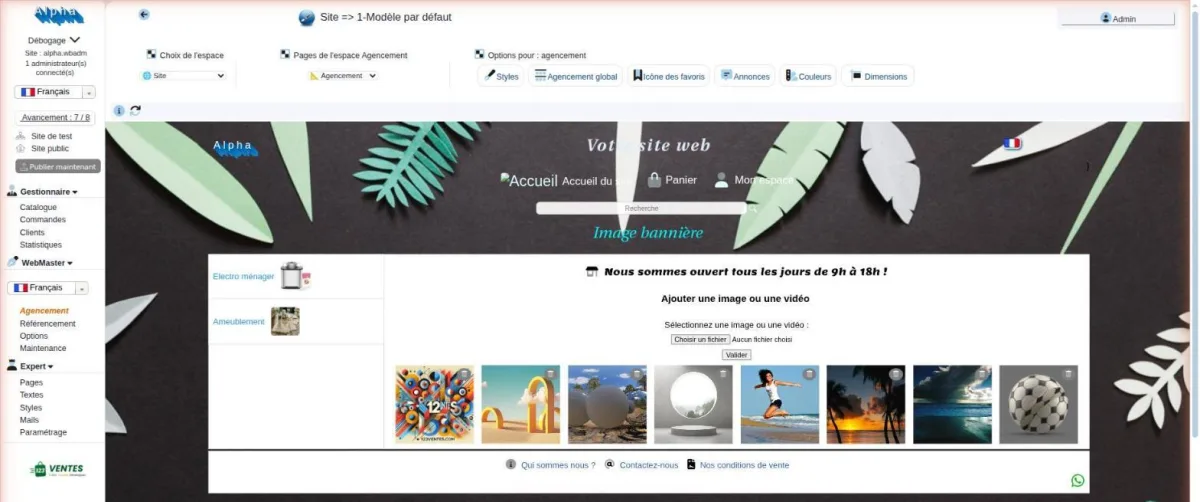
123Ventes is an online platform designed for makers and small shops: €29.90 a month or €319.90 a year, with no commission on your sales, including hosting, security, card and PayPal payments, delivery and in-store collection. You can use your own domain name, and a real person answers your questions.
And if you don’t have time to build it yourself, we can do it for you: that’s our turnkey shop creation service. You get the comfort of an agency at the price of a platform. All prices are on the pricing page.
Frequently asked questions
How much does it cost to build an e-commerce website?
For a small shop, expect €200 to €800 in the first year if you do it yourself with open-source software, €2,000 to €10,000 with an agency, and €250 to €600 with an online platform. Add commissions on sales if your solution charges them. At 123Ventes: €319.90 a year or €29.90 a month, with no commission.
How long does it take to build an e-commerce website?
A few days with a platform, if your photos and copy are ready. A few weeks to a few months if you build it yourself. One to three months with an agency. Whichever route you take, what takes the longest is the product photos and descriptions.
Can you build your own e-commerce website without knowing how to code?
Yes. With an online platform, everything is done from a dashboard: you choose a theme, add your products, and set up payment and delivery. Not a single line of code is needed. Open-source software, on the other hand, requires more technical confidence for installation and maintenance.
Do you need a legal status to sell on your own website?
Yes. In France, as soon as you sell on a regular basis, you need a legal status (micro-entreprise, registered craftsperson, company…) as well as a legal notice and terms of sale on your website. We cover all of this in our article on the legal obligations for selling your creations online.
Can you switch to another solution later?
Yes, provided you have kept the domain name in your own name and can export your products and customers. Check these two points before choosing: they save you from starting from scratch the day your business grows.
Conclusion
When building an e-commerce website, start by asking yourself two questions: how much time do you want to spend on it, and how much do you want to spend before you’ve sold anything at all? If you enjoy the technical side, do it yourself. If you have a big budget and a specific need, hire an agency. If you simply want to sell your products, a platform is still the shortest route between your workshop and your customers.
With 123Ventes, you build and test your shop without paying a penny: the subscription only starts with your first order. In other words, you only pay once you sell.
👉 Try 123Ventes for free and see what your shop could look like.