Online shop for craftspeople: selling what you make, without spending your evenings on it
A craftsperson’s online shop comes down to three things: a catalogue of your creations with good photos, secure payment, and a way of getting the order to the customer, by parcel or at the workshop. Nothing more to get started.
With 123Ventes, the shop costs 29.90 € a month or 319.90 € a year, hosting included, and we take no commission on your sales. You fill it yourself, or you hand it over to us for 400 €, once and for all. This page explains what you need to plan, what it really costs, and how to get started without giving up all your Sundays.
Why sell online when you are a craftsperson?
Because your customers are not always standing in front of your stall. The visitor to the Christmas market who hesitated over a vase thinks about it again the following Tuesday. If they find nothing when they type in your name, they buy something else, somewhere else. If they find your shop, they order from the sofa, in their slippers.
An online shop doesn’t replace the workshop, craft fairs or word of mouth. It carries them on: open at night and on Sundays, while you are at the kiln. Your loyal customers reorder without phoning you, and summer tourists find you again in winter.
And finally, it is your own shop window. Your prices, your texts, your photos, your customer file. Nobody changes the rules halfway through the game.
What does a real craftsperson’s shop look like?
Here is the one belonging to Josy Dienot, a ceramicist in Pau: Terra Nostra Céramique. Stoneware, raku, porcelain, crystalline glazes, sculptures… and even a book on glazes. Every piece is unique: each one has a stock of 1, and once it is sold, nobody can order it any more.
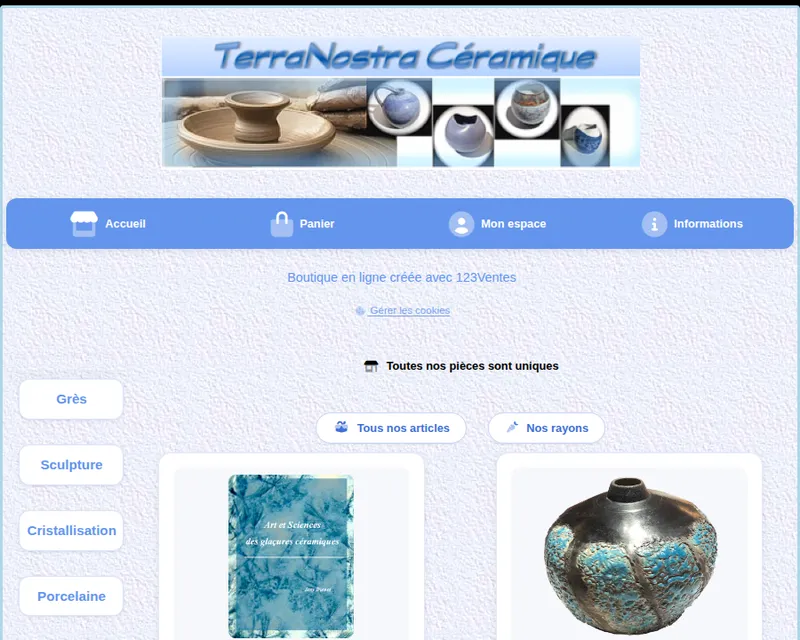
“I wanted to spend my time in the studio, not in front of a computer. I add my pieces as they come out of the kiln, and the book sells itself, even when I’m away teaching a course.”
More of our customers’ shops are on the references page.
How should I present my creations online?
On the internet, the customer can’t touch, weigh or turn the piece over. The product page has to do it for them. In 123Ventes, each product page takes:
- a main photo and four views: left, right, top, bottom. The signed base of a bowl, the inside of a seam, the clasp of a necklace: that is where good work shows;
- a video, for example the piece turning or your hands at work;
- a short description to make people want it, and a long description formatted as in a word processor, to explain everything;
- the weight, dimensions, material and colour, and a PDF leaflet if needed (care, composition).
For photos, a window, daylight, a plain background and your phone are enough. And give the measurements: “small bowl” means nothing, “12 cm in diameter” does.
You sort your products into categories and subcategories, like your shelves, and there is no limit on how many. Two hundred items in a spreadsheet? Bulk import accepts a CSV file and a ZIP archive of the photos. Everything is explained on the catalogue management page.
One-off piece, small run or made to measure: how do I manage stock?
It is the question that worries craftspeople most, and yet it is the simplest.
- One-off piece: you set the stock to 1. As soon as it is sold, it can no longer be ordered. Nobody pays for a vase that has already gone home with someone else. You can leave it online marked “Sold”: your shop also becomes your gallery.
- Small run: you enter the real stock, and you offer the variants (colour, size, finish) as options on a single product page, with or without an extra charge.
- Made to measure or made to order: you show a making time, for example “4 weeks”. The customer knows that doing things well takes time, and won’t chase you after three days.
You also sell at markets? The 123Ventes till records sales on the stall, with the same stock as the shop. The last item sold on Saturday morning isn’t sold a second time online on Saturday evening.
Payment, delivery, collection from the workshop: how does the customer get their order?
Payment. Your customers pay by card with Stripe or PayPlug, by PayPal, by bank transfer or by cheque. The card number is never entered or stored in your shop. Allow about 1.5% + 0.25 € in Stripe fees per payment in Europe, or roughly 1 € on a 50 € order. With PayPlug, the card rate is the same, plus a subscription of 10 € excl. VAT a month. Details on the secure online payment page.
Delivery. Colissimo to the door or to a collection point, Mondial Relay to a pick-up point, DPD, and ShippyPro, which brings together many carriers, including Chronopost, DHL and UPS, in a single account. Shipping costs are worked out automatically, by weight band and by country zone. You can deliver only in France, and offer free delivery above a set amount.
Collection from the workshop. For a 15-kilo storage jar or a farmhouse table, nothing beats the customer coming to pick up their order. No box, no breakage, and they sometimes leave with one more piece. You can also deliver yourself in your area.
All the options are on the delivery options page. For orders, the Real time screen rings at every new sale, the PDF invoice is created as soon as payment is made, and the customer receives an e-mail at each stage: paid, shipped, received.
How much does a craftsperson’s online shop cost?
At 123Ventes, the price fits on one line: 29.90 € a month or 319.90 € a year, with hosting and the security certificate included, and no commission on your sales. A domain name in your own name costs 17 € a year. The only fees on top are your payment provider’s.
For a fair comparison, here is the cost of a small craftsperson’s shop over one year, with the cheapest plan of each solution and annual payment:
| Over one year | Shopify Basic | Wix Core | 123Ventes |
|---|---|---|---|
| Subscription | 324 € (27 € a month) | About 360 € (30 € a month) | 319.90 € |
| Apps | Often 120 to 360 € | Often 120 to 360 € | None: the features are included in the subscription |
| Card fees | 1.5% + 0.25 € (Shopify Payments) | 1.9% + 0.30 € (Wix Payments) | 1.5% + 0.25 € (Stripe) |
| Platform commission | 2% if you keep your own payment provider | No | No |
| Total excluding card fees | From about 335 € to over 1,000 € | From 360 € to over 700 € | 319.90 €, or 336 € with your domain name |
Let’s be honest: on the subscription alone, it is almost a draw. The difference comes from what you add afterwards. An app here, a module there, and the bill doubles without anyone really deciding it should. Payment fees count too: for 15,000 € of sales in a year, or 300 orders of 50 €, Wix Payments takes about 375 €, Stripe about 300 €.
If you would rather not set anything up yourself, the turnkey set-up costs 400 €, once and for all. Support starts with 1 hour 30 minutes free, then 50 € an hour if you want more. The details are on the pricing page, and the full comparisons are on Shopify alternative and Wix alternative.
Shopify and Wix public prices for France, checked in October 2026. The cost of apps is an estimate: it depends on what you choose.
How do I start my online shop, step by step?
- Choose ten pieces. Not the whole workshop: your ten best sellers, photographed in the same place, with the same light.
- Create your shop from the sign-up page, then choose a theme and add your logo and colours. Layout mode lets you change the page while looking at it, with a right-click.
- Add your products: photos, texts, price, weight, stock. The VAT rate is set product by product.
- Set up payment and delivery: tick the carriers that suit you and collection from the workshop, and connect Stripe or PayPal.
- Test. Test mode lets you place a dummy order before opening. Buy yourself a bowl: it costs nothing.
- Get your domain name. It is registered in your name and you keep it if you leave. Already have one? It stays with your registrar; we simply point it to your shop.
- Open and spread the word: the address on your business cards and labels, a QR code on your stall, a first newsletter to your customers. Newsletters are included. And to combine your shop, Etsy, social media and Google, read our guide to selling your creations online.
The terms of sale are provided as an up-to-date template, with the 14-day right of withdrawal under French consumer law and its exceptions, for example for made-to-measure pieces. Read them through and adapt them to your business.
Which online shop for your trade?
Every trade has its own little questions: breakage for the potter, labelling for the soap maker, sizes for the dressmaker, bulky parcels for the cabinetmaker. Choose yours, and the matching page answers them in detail.
Craftspeople and makers
 Online shop for pottersOne-off pieces, breakage-free shipping, classes and workshops.
 Online shop for soap makersSoaps, balms and candles: labelling, light parcels, loyalty.
 Online shop for candle makersCandles and wax melts: scents as options, labelling, parcels that neither break nor melt.
 Online shop for jewellery makersSizes and engraving as options, small parcels, gifts and holidays.
 Online shop for dressmakersSizes, fabrics, made-to-measure, returns: everything textile.
 Online shop for woodworkersWood types and finishes to choose, bulky furniture, made-to-measure.
 Online shop for leather goodsBags and small leather goods: colours, engraving, careful parcels, shop and web.
 Online shop for stationeryCards, posters and announcements: sizes as options, personalisation, flat shipping, stockists.
Building trades


Food trades and shops
 Online shop for delisFresh produce for collection, dry goods shipped, gift hampers.
 Online shop for chocolatiersChocolate boxes and gift sets: in-store collection, parcels in winter, holiday orders.
 Online shop for beekeepersSingle-variety honeys, hive products: stock by harvest, well-padded jars, sales at the honey house.
 Online shop for pizzeriasOnline ordering for takeaway or delivery, with no commission.
 Online shop for food trucksPre-orders at today’s pitch, limited quantities, loyalty.
 Online shop for takeawaysBurgers, kebabs, tacos: sauces, extras and meal deals online.
 Online shop for sandwich shopsLunch deals for collection, platters and business orders.
 Online shop for clothing storesSizes and colours, sales, in-store collection, stock shared with the till.
 Online shop for floristsBouquets and plants: local delivery, in-store collection, message card, holiday orders.
Your trade isn’t there? Cheesemonger, bookseller, bookbinder, glassmaker… the principles on this page still apply. And if you’d like to see real shops, have a look at the references.
Your questions
Does 123Ventes take a commission on my sales?
No. The subscription is fixed, 29.90 € a month or 319.90 € a year, whatever your turnover. Only your payment provider’s fees are added, about 1 € on 50 € paid by card.
Do I need to know how to code to create my online shop?
No. Everything is done from the management area, like filling in a form, including on a phone. If you want to hand it over, the turnkey set-up costs 400 €.
How do I sell a one-off piece without selling it twice?
Set the stock to 1. Once the piece is sold, it can no longer be ordered, and you can leave it visible marked “Sold”.
Can my customers collect their order from the workshop?
Yes. Collection from the workshop is a delivery method like any other: the customer orders and pays online, then comes to pick up their piece.
I already sell at markets: how do I avoid selling the same product twice?
Record your stall sales with the 123Ventes till: it shares the online shop’s stock.
Do I need a special business status to sell online?
The same one as for markets: the online shop is simply one more sales channel. Check that distance selling is covered by your declared business and, if in doubt, ask your chamber of trades (chambre de métiers).
Create my shop