Selling your handmade creations online: the maker’s guide to choosing your channels
Published on 9 min read The 123Ventes team

You make bowls, jewellery, soaps or bags, and you would like to sell them somewhere other than the Saturday market. Good news: for a craftsperson, selling online has never been easier. Less good news: between Etsy, Instagram, Facebook, Google and your own shop, it is easy to get lost, and every channel takes a little of your time or your margin.
This guide sorts it all out: what each channel really brings, what it costs, and how to combine them without spending all your evenings on it.
5 questions to ask yourself before selling online
Before choosing a tool, take ten minutes to answer these questions. The answers decide almost everything else.
- Hobby or business? A few sales to pay for your materials, or a regular income? Either way you need a business status as soon as you sell regularly, but the ambition will not be the same.
- How many pieces per month? Three unique pieces or fifty identical soaps call for very different organisation.
- How much time per week? Photos, product pages, parcels, messages: count at least two to three hours a week for a small online business.
- Do your creations travel well? A necklace fits in an envelope, a 15-kilo jar much less so. In-store or workshop pickup can then change everything.
- Who are your customers today? Market regulars, passing tourists, Instagram followers? You always sell first to the people who already know you.
Write your answers down somewhere. Read them again in six months: they will tell you whether you have drifted towards a channel that costs you more than it brings in.
Selling online or at the market: what really changes
Selling online does not replace the contact of the workshop or the market stall. It is a different job, with its own rules. Here are the main differences:
| At the market, in the workshop | Online | |
|---|---|---|
| The customer | Touches, weighs, asks questions | Only sees your photos and your texts |
| Opening hours | When you are there | Day and night, even while the kiln is firing |
| The area | Your town, your region | The whole country, and beyond |
| Trust | Your smile and your stall | Reviews, legal notices, secure payment |
| Competition | The neighbouring stalls | One click is enough to compare with a hundred others |
| Extra work | Setting up the stall, handling the cash | Photos, product pages, parcels, messages |
| The rules | Those of direct selling | Those of distance selling: 14-day right of withdrawal in the EU, terms of sale, mediator |
Remember the first line above all: online, your photos and your texts do the work of your hands. That is where the sale is made, whatever the channel. Natural daylight, a plain background and five views of each piece are enough to start.
5 ways to sell your creations on the Internet
There is no single right channel, there is a right combination. Here are the five main families, with what they bring and what they cost:
| Channel | What it brings | What it costs | Are the customers yours? |
|---|---|---|---|
| Marketplaces (Etsy…) | Visitors already looking for handmade goods | About 13% per sale on Etsy | No |
| Social media | A community, visibility | Free, but a lot of time | Partly |
| Your own online shop | Your rules, your customer list, no commission | A fixed subscription, from €29.90 a month | Yes |
| Google (profile and products) | Customers searching near you | Free, or pay-per-click with Google Ads | Yes, if they land on your shop |
| Local sales (pickup, consignment) | No parcels, loyal customers | Almost nothing | Yes |
Let’s look at them one by one.
1. Marketplaces: Etsy and the others
A marketplace is an online shopping mall: visitors come for the mall, not for you. Etsy is the best known for handmade goods; Amazon Handmade and smaller marketplaces dedicated to makers also exist.
Their strength: buyers who are already searching for “stoneware mug” or “handmade silver ring”. Their weakness: a commission on every sale, rules that change without asking you, and customers who remain the platform’s. On Etsy, a €50 order costs about €6.30 in fees for a seller based in France.
It is an excellent way to start or to test a product. For the detail of the fees over a year and when your own shop becomes cheaper, read our Etsy alternative for makers.
2. Social media: your shop window, not your till
Instagram, Facebook, Pinterest, TikTok: social networks are perfect for showing your work. Behind the scenes in the workshop, a piece coming out of the kiln, your hands sewing: this is exactly what people love to see, and what no big brand can copy.
On the other hand, they handle neither stock, nor invoices, nor shipping costs. Selling only through private messages quickly means bank transfers to check, pieces promised to two people and evenings on your phone. The right method: the network creates the desire, the shop takes the payment. Every post leads to the product page, where the customer pays securely.
In France, Facebook and Instagram shops are shop windows: the customer sees the product in the app, then completes the purchase on your website.
123Ventes: unlimited products, card and PayPal payments, Colissimo, Mondial Relay or workshop pickup. €29.90 a month, free trial with no time limit.
3. Your own online shop: where customers become yours
Your shop is your workshop with a shop front on the street: your domain name, your colours, your prices, and above all your customer list. When you release a new collection, you can tell the people who have already bought from you, without paying a platform to show you to them.
The downside: nobody walks past by chance. You bring the visitors yourself, with your social media, your business cards, your labels, your stall and Google. That is why a shop works so well together with the other channels: it is where they all lead.
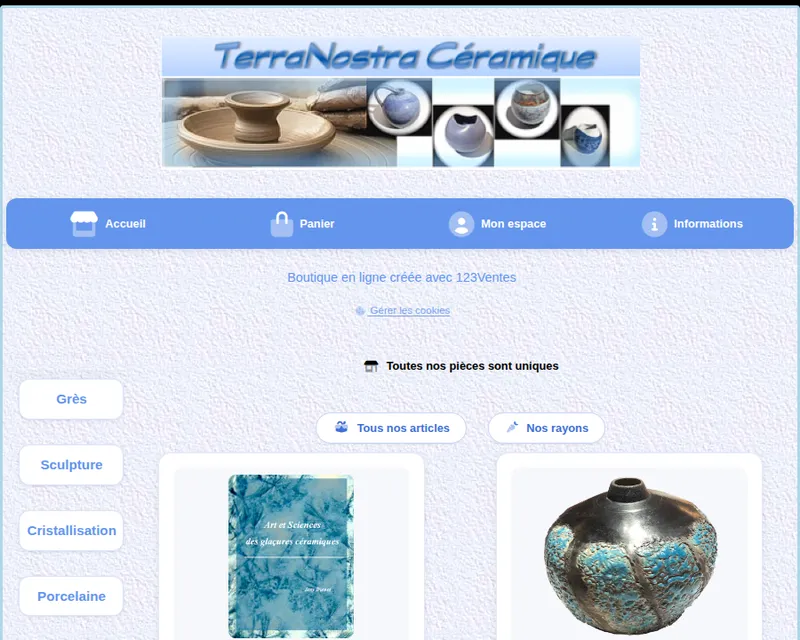
What you need at the very least: well-presented product pages, secure payment, suitable delivery options, terms of sale and legal notices. To see how it works for your trade, look at our pages for jewellery makers, potters and ceramicists or all trades, and our complete guide to creating an online shop.
4. Google: being found by people who are searching
When someone types “ceramicist Pau” or “handmade donkey milk soap”, they already want to buy. There are three ways in, two of them free:
- Your Google Business Profile: your workshop on Google Maps, with your opening hours, photos, reviews and the link to your shop. Free, and often a local customer’s first contact with you.
- Free product listings: with a Google Merchant Center account, your products can appear free of charge in the Shopping tab and in Google Images. Google can read the price and availability shown on your product pages.
- Google Ads: pay-per-click ads, useful to speed things up, provided they are set up carefully: a small daily budget, precise keywords, and each ad leading to the right product.
And of course organic search, which you build product page after product page: see the SEO of your online shop.
5. Local sales: the forgotten channel
Selling online does not mean shipping everything. Many makers make a good share of their online sales with customers… who live twenty minutes away. The customer orders and pays online, then comes to the workshop or the market: no box, no breakage, and often one more piece bought on the spot.
Add consignment with a neighbouring shop, makers’ markets and open-studio days: your online shop then becomes a permanent catalogue between two meetings. Workshop pickup and local delivery are explained on our delivery options page.
Which combination for your situation?
- You are just starting and nobody knows you: a marketplace to be discovered, an Instagram account to show your workshop. Open your own shop as soon as your first customers come back.
- You already sell at markets: your own shop first. Your customers look for you by name: don’t send them to a platform that takes 13%. A card with your shop’s address in every bag, and you are done.
- You have a workshop-shop: an online shop with pickup on site, a well-kept Google profile, and a newsletter for your regulars.
- You sell consumables (soaps, candles, honey, cosmetics): your own shop above all, because your customers come back, and every order without commission counts.
Two well-run channels are worth more than five abandoned ones. Choose one that gets you discovered and one that keeps your customers, and only add another once both are running smoothly.
Price, photos, law: three tasks common to every channel
Whatever the channel, three topics always come back:
- Price: it must cover your materials, your time, your fixed costs, any commissions and your social contributions. Calculate it per piece before choosing a channel, not after.
- Photos: daylight, a plain background, five views per piece. Your phone is enough.
- Obligations: business status, legal notices, terms of sale, right of withdrawal, warranties, consumer mediator. Our page on the real cost of an online shop also lists the costs not to forget.
Regularly selling your creations, even online and even “to make ends meet”, is a professional activity: in France you need a business status, often that of micro-entrepreneur. If in doubt, your local chamber of trades and crafts (chambre de métiers et de l’artisanat) will advise you free of charge.
Your plan for the first month
- Week 1: choose ten pieces, photograph them in the same place, work out their price.
- Week 2: open your shop or your marketplace account, write the product pages, set up payment and delivery.
- Week 3: create or complete your Google profile and your Instagram account, with the link to your shop.
- Week 4: tell your current customers (market, workshop, friends and family), slip a card into every parcel, and note where your first orders come from.
The first sales almost always come from people who already know you. That is normal, and it is excellent news: they are the ones who will talk about you. To get more visitors, read our tips on getting your shop found on Google.
Frequently asked questions
What is the best website to sell your creations?
There is no single one. Etsy is handy to get discovered but takes about 13% per sale. Your own shop costs a fixed subscription and keeps your customers yours. Most makers benefit from combining the two, with Instagram or Facebook as a shop window.
Can you sell your creations online without a business status?
An occasional sale of personal items, yes. But as soon as you make things to sell them regularly, it is a professional activity: in France you must register a business, often as a micro-entrepreneur. Your local chamber of trades can advise you.
How much does an online shop cost for a maker?
With 123Ventes, €29.90 a month or €319.90 a year, hosting included and with no commission on your sales. Add the payment provider’s fees, about €1 on €50 paid by card, and a domain name if you want one.
Can you sell directly on Instagram or Facebook?
In France, Facebook and Instagram shops are mainly shop windows: the customer sees the product in the app, then completes the purchase on your website. So you need an online shop to take payments.
How much time should you spend on selling online?
Count two to three hours a week for a small business: adding products, answering messages, preparing parcels, posting on one social network. Getting started takes more, especially for photos and product pages.
Conclusion
To sell your creations online, you don’t need to be everywhere. One channel to be discovered, one channel to keep your customers, and good photos to do the work of your hands. The rest will come with the first sales.
👉 Try 123Ventes for free: you set up your shop with no time limit, and you only pay once your first order comes in.